RSS Feed (xml)
Well Ladies and Gentlemen,
Due to the recent economy, suffice to say, there hasn't been much to post on this blog.
So, I'd like your help. If you know of any developments in your area, please email me (alephew at gmail.com) so you can share the good news with everyone! Now since there is much un-development happening, let's report on that as well.
When I created this blog (my first), I did it to help out my previous employers (condo developers) find localized information. This was to aide them in making purchasing decisions, as well as create bank packages to apply for mezzanine funding. My first blog has stretched it's legs since then.
Let's pool our resources to help those who still want to open business in our communities. Anything that you think will help others succeed, or save them from making a poor choice, send it! Pictures, stories, articles, you send it, we'll post it, and of course provide the source (unless anonymity is requested).
Email alephew at gmail.com
Photographer: Unknown
Lack of Development


"People who say we can't do anything about congestion are wrong. We can do lots,"
It would also reduce air pollution from vehicles by as much as a fifth, cut accidents at intersections and save about five tanks of gas annually per household, according to the National Transportation Operations Coalition, an alliance of federal, state and local traffic departments and equipment-makers. That's the good news. The bad news is that the average local traffic department earned an overall grade of D on the alliance's latest report card. Streamlining intersections is happening in only some cities and states, even though it's eminently doable. "People who say we can't do anything about congestion are wrong. We can do lots," said Joel Marcuson, a specialist in urban intersections with the Jacobs Engineering Group Inc. in Phoenix. Right now, however, three out of four of the nation's 300,000 traffic signals need replacement or timing adjustments for optimum performance, according to the U.S. Department of Transportation. Among the obstacles are a nationwide shortage of skilled traffic engineers, unfocused local political leaders with tight budgets and stodgy local traffic departments. For that matter, federal aid that could ease congestion goes mainly to building and maintaining roads. Nonetheless, lots of cities and at least seven states — California, Florida, Washington, Minnesota, Maryland, Georgia and Texas — are finding ways to move traffic through intersections faster, according to the transportation engineers group. Georgia focuses much of its energy on the 20-county area around Atlanta when it comes to traffic signal improvements. Since 2005, it has cut travel time in Atlanta's traffic corridors by 18 percent and time stopped by 39 percent, said Yancy Bachmann, assistant state traffic engineer. Macon and Columbus have also seen traffic signal improvements, he said. And where does your metropolitan area stand? It could need improvement, traffic engineers say, if your answer is no to any of these questions: —Can you sometimes make it through six to eight consecutive intersections on green lights? —Is there useful traffic information on the radio and on roadside message signs? —Is it rare that there's no cross traffic when you're stopped at a light? —Can you drive into the next jurisdiction without encountering congestion at the border? —Are predictable traffic jams, such as the post-game exits from stadium parking lots, handled adroitly?
McClatchy Newspapers
Published on: 05/14/08
WASHINGTON — Fine-tuning controls on the nation's traffic signals would cut U.S. road congestion by as much as 10 percent, transportation experts estimate.
Boston again near the top in economic vitality index
Boston Business Journal - by Jesse Noyes Boston Business Journal
For the second consecutive year, Boston took a top spot in a list of the most competitive metro areas in the country.
Greater Boston ranked second in level of competitiveness, beat out by Salt Lake City, among 50 city regions in 2007, according to the annual "Metro Area Competitiveness Report" compiled by the Beacon Hill Institute at Suffolk University. It was the second year Boston held the position, beating other regions such as Denver, Portland, Ore., Seattle and San Jose, Calif.
The rankings are put together by measuring various factors, such as technology, infrastructure and human resources, and then providing an overall index of each region's overall competitiveness.
For 2007, the Boston area received an index of 7.38, behind Salt Lake City's 7.57. Each year since the report began being compiled in 2001 Boston has managed to stay "fairly systematically at or near the top," said Jonathan Haughton, a professor of economics at Suffolk University and an author of the report.
What pushes Boston to a top spot in the rankings are its competitiveness in the technology field, where it ranked first, and human resources, for which it ranked second behind Minneapolis. Technology rankings are configured by looking at research funding, patents issued and the number scientists located in the area, while human resources largely looks for a skilled workforce that is not abundantly expensive.
Where the region lags is in areas like infrastructure, which includes issues like commuting time, energy costs and affordable housing. Boston falls near the bottom of the list in the infrastructure category with a ranking of 47.
Brian Gilmore, a spokesman for the Associated Industries of Massachusetts, called the Suffolk University report "good news" and "bad news." Problems, such as high rents and taxes, could drag on Boston's rankings, especially as regions off the West and East Coasts position themselves as competitors for large businesses outside traditional technology centers, he said.
"All regions of the country are trying to reinvent themselves," Gilmore added. "We haven't got the whole playpen to ourselves."
But despite Boston's old structure and struggle with major public transportation development such as the Big Dig, the area is going through a positive transformation, said Paul Guzzi, president and CEO of the Greater Boston Chamber of Commerce. "When you look at the link now that is being created between the downtown Financial District, the Greenway and the Seaport District, that opens up incredible opportunities," he said.
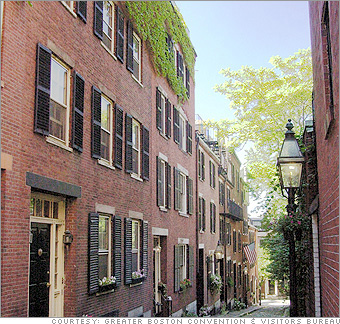 The strangest occurrence might be Boston's finishing behind Salt Lake City in terms of competitiveness. Haughton said despite Boston's higher ranking in human resources and technology, Salt Lake City does well across almost every category. Salt Lake City took the top ranking for infrastructure and bested Boston in the business incubation category.
"What Salt Lake City has done, though its strengths are quite different (from Boston's), is that it doesn't really do badly on anything," Haughton said.
Jesse Noyes can be reached at jnoyes@bizjournals.com.Mixed-Use Project at the Russia Wharf
Written by Boston Business Journal
Wellington Management Co. LLP has inked a deal to occupy 450,000 square feet of space at Russia Wharf, capping one of Boston's largest lease deals in recent months.
 Boston Properties Inc. (NYSE: BXP), which is building a 552,000-square-foot office tower at the site, quietly highlighted the lease deal in its fiscal 2008 first-quarter earnings announced on Wednesday.
Wellington spokeswoman Lisa Finkel declined to comment, other than saying that the news in Boston Properties' financial statement was correct.
Boston Properties said Wellington signed a 15-year lease agreement on April 22. The lease is scheduled to begin in spring 2011.
Wellington has taken steps in recent months to ensure a smooth transition from three other properties it leases. Owners have listed space Wellington currently leases at 75 and 28 State St. as available for lease.
Wellington earlier this year was also reportedly negotiating a two-year interim lease at its third location at 200 State St. until Russia Wharf is ready.
Wellington will stay at 200,000 square feet of space it leases at 100 Federal St.
Russia Wharf will include a 31-story office building, and also residential space to be build into the shell of three brick buildings remaining at the site.
Wellington's lease represents 82 percent of the total, 815,000 square-foot mixed-use project.